
Custom Railing / San Ramon & Tri-Valley
Glass Railings in San Ramon, CA
Tempered and laminated glass guards for decks, pool terraces, balconies and stair landings, anchored to engineered details and glazed to current code.
- Licensed & InsuredEvery job
- In-Shop FabricationBuilt to measure
- Free On-Site EstimatesWritten ranges
Glass Railings in San Ramon, Clear From Every Angle
We build glass railings in San Ramon for decks, pool terraces, balconies and interior landings where the owner wants the guard to vanish. Glass gives you the view with no lines through it, cuts the afternoon breeze on an exposed deck, and keeps kids and pets on the right side of the edge.
It is also the least forgiving railing to get wrong. Panel size, glass build-up, mounting hardware and the structure underneath all have to agree, and glass is cut to order, so a measuring mistake costs weeks. Call (925) 438-6219 and we will review your edge, your view and your budget together.
What's Included in a Glass Railing Project
- An on-site review of the mounting surface, waterproofing and framing.
- Drawings showing panel layout, glass type, thickness and hardware.
- Coordination with an engineer when the system or the building department calls for calculations.
- Base shoe, standoffs or spigots in stainless or powder-coated aluminum.
- Glass ordered only after hardware is set and templated.
- Installation, glazing, top caps and a final cleaning.
Who Chooses Glass
- Pool decks where parents want to watch swimmers through the guard.
- Modern remodels and newer homes with large windows and clean lines.
- Interior lofts and open-to-below landings that need a guard without visual weight.
- Windy, exposed decks where cable would leave you in the breeze.
Glass is not for every project. It costs more, shows water spots and spring pollen, and needs a solid substrate. On an older deck over a slope, we may recommend cable or aluminum instead.
Glass Types and Mounting Systems
Tempered glass is heat-treated and breaks into small pellets. Laminated glass bonds two lites to an interlayer so a cracked panel stays in place. For most guards we specify laminated tempered glass, typically 1/2 inch to 3/4 inch overall depending on span and mount.
| Mounting | Look | Where it works | Trade-offs |
|---|---|---|---|
| Base shoe | Fully frameless | Concrete or steel edges, level decks | Highest cost; needs a strong, waterproofed substrate |
| Standoffs | Floating panels with discs | Deck and stair fascias | Keeps the walking surface open; holes drilled in glass |
| Spigots | Minimal clamps | Pool decks, terraces | Each spigot anchored separately; small gaps between panels |
| Post and clamp | Semi-frameless | Longer runs, tighter budgets | More metal in the view |
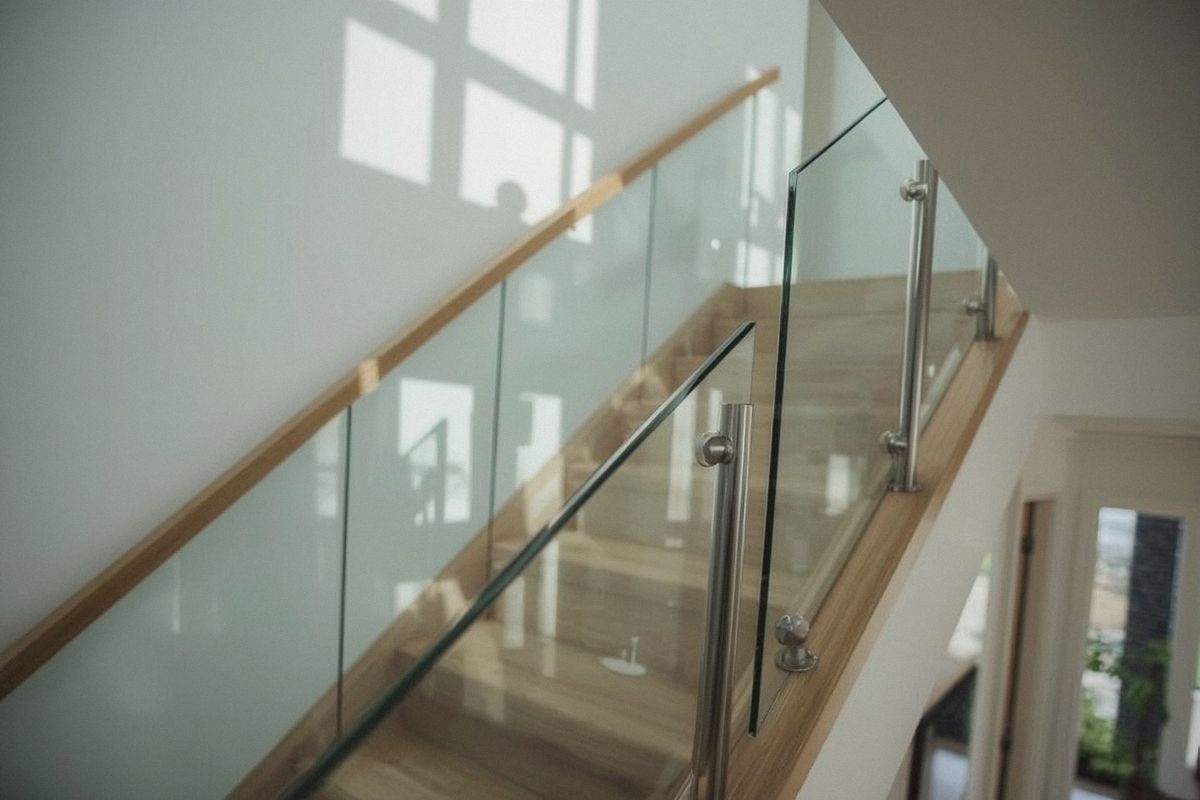
Glass Railing Code Compliance
Glass in a guard must be safety glazing. Current California Building Code provisions for glass guards generally call for laminated glass, and some configurations need a top rail or cap that keeps working if a panel breaks. The guard still must reach 42 inches where the surface is more than 30 inches above grade, resist a 200-pound load along the top, and gaps between panels cannot pass a 4-inch sphere.
We confirm glazing type, cap requirements and anchorage with the engineer and building department before any glass is ordered, so nothing gets rejected at inspection.
Our Process
Site Review
We check the edge, the waterproofing and the structure that will hold the glass.
Layout & Glazing Plan
Panel widths, joints and glass build-up are drawn to your view.
Engineering & Permit
Anchorage and glass specs are confirmed and submitted where required.
Set Hardware
Shoe, spigots or standoffs are installed, leveled and through-bolted.
Template & Order Glass
We measure the installed hardware, then order glass to those numbers.
Glaze & Finish
Panels are set, shimmed, capped and cleaned for a final walk-through.
Built for San Ramon Valley Conditions
Glass guards here have to respect the Calaveras Fault. USGS describes it as bounding the western side of the San Ramon Valley with slip of about 5–6 mm a year, and the state maps Alquist-Priolo zones along it from west San Ramon south into Dublin and Pleasanton. A glass guard is heavy and rigid, so anchorage is the heart of the job: through-bolted shoe or spigots into engineered blocking or concrete, setting blocks that keep glass off hard metal, and laminated panels that stay put if one cracks. Summer sun matters too, so we favor stainless or lighter shoe covers that stay cooler.
Glass Railing Cost in San Ramon
Glass is the premium tier, typically $150–$600 per linear foot installed. Few railings vary as much in price, since glass build-up, panel dimensions and the mounting method each shift the total. Expect the upper end for:
- Base shoe systems and tall, wide panels.
- Low-iron glass that removes the green edge tint.
- Corners and turns, which add roughly 20–30%.
- Stairs, engineering and permits, which typically run $50–$500.
- Hillside lots where panels must be carried in by hand.
Before you decide, our guide to California railing height and spacing rules explains the code side. For a firm price, call (925) 438-6219.
Why Choose Us
Glass Ordered Off Templates
We never order glass from a pre-construction sketch. Hardware goes in first, gets leveled and bolted, and only then do we template the actual openings and send those numbers to the glass supplier. That one step prevents the most expensive mistake in glass railing work: panels that arrive a quarter inch off and have to be remade from scratch.
Anchorage Drawn for Fault Country
With the Calaveras Fault running along the west side of the valley, we treat every glass guard as a structural connection. Shoe and spigots are through-bolted into blocking or concrete per the engineered detail, never just glued or lagged into a rim joist. Laminated panels add a second layer of safety if a panel is ever struck or cracked.
Straight Answers on Glazing
Tempered or laminated, cap or no cap, base shoe or spigots: these choices affect safety, cost and how the railing looks. We explain each one in plain English, show you the code reason behind it, and write the final specification on your drawing so you, your HOA and the inspector all see the same thing. That shared document is what keeps the final inspection uneventful.
Available Across the Tri-Valley
We install glass railings in Pleasanton, San Ramon, Dublin, Danville, Walnut Creek and Alamo. Each department has its own submittal portal, and glass guards are a detail plan checkers look at closely, so we plan the paperwork with the panels.
Related Services
Compare a lower-cost view option in our cable railings, explore all deck and balcony railings, add glass to a loft through interior stair railings, or see aluminum railings for a framed alternative. Learn about our shop or schedule a glass railing estimate.
FAQ
Questions, Answered
Straight answers on cost, code, permits and materials. Still unsure? Call and ask.
Tempered or laminated glass: which do I need?
Tempered glass is stronger than ordinary glass and crumbles into small pieces if it breaks. Laminated glass holds together on its interlayer, so a broken panel stays in the opening. For most exterior and interior guards, current code points toward laminated glass, usually laminated tempered. We confirm the exact requirement with your building department before ordering.
Does a glass railing need a top rail?
Sometimes. Certain glass guard systems must include a top rail or cap that keeps protecting the edge if a panel fails, and stairs always need a graspable handrail at 34–38 inches. Some engineered frameless systems qualify without a cap. We look at your configuration, explain what applies, and show the result on your drawing.
How do I keep a glass railing clean?
Rinse panels with a hose to knock off dust and spring pollen, then use a squeegee or soft cloth with a mild glass cleaner. Avoid abrasive pads that can scratch. Sprinklers aimed at the railing leave mineral spots, so adjusting heads helps a lot. Most owners do a quick cleaning every few weeks in summer.
Can glass railing go on my existing wood deck?
Often, yes, using standoffs or spigots on the fascia or through the deck with added blocking. The framing has to be sound and stiff enough to hold the glass without flexing. We inspect the joists and rim before quoting; if the deck is near the end of its life, we will tell you before investing in glass.
Will a glass railing help on a windy deck?
Yes, that is one of its best features. A glass guard blocks much of the breeze at seated height while keeping the view, which makes exposed hillside decks more usable on breezy evenings. The flip side is that the glass must be designed and anchored for that wind load, which is part of our engineering review.
Free on-site estimate
Ready to get started?
San Ramon Custom Railing designs, fabricates and installs custom railings across San Ramon, CA and the Tri-Valley. Licensed and insured, drawings checked against California code, and permit and HOA paperwork handled for you.