
Custom Railing / San Ramon & Tri-Valley
Cable Railings in San Ramon, CA
Stainless cable railings that keep the hills in view, laid out with tight post spacing and tensioned to pass the 4-inch sphere test.
- Licensed & InsuredEvery job
- In-Shop FabricationBuilt to measure
- Free On-Site EstimatesWritten ranges
Cable Railings in San Ramon for View Decks
We design and install cable railings in San Ramon for homeowners who would rather look at Mt. Diablo or the Las Trampas ridgeline than at a row of pickets. Thin horizontal runs of stainless cable nearly disappear from a deck chair, yet a well-built system is a full code guard.
The catch is that cable only works when the frame is right. End posts carry the pull of every cable in the run, and a loose layout lets cables spread apart. We fabricate the frame in our shop, set it on your deck and tension each run ourselves. Call (925) 438-6219 for a free on-site look.
What a Cable Railing Project Includes
- A site visit to check deck framing, blocking and the sightlines you want to keep.
- Drawings showing post spacing, cable count and fitting types.
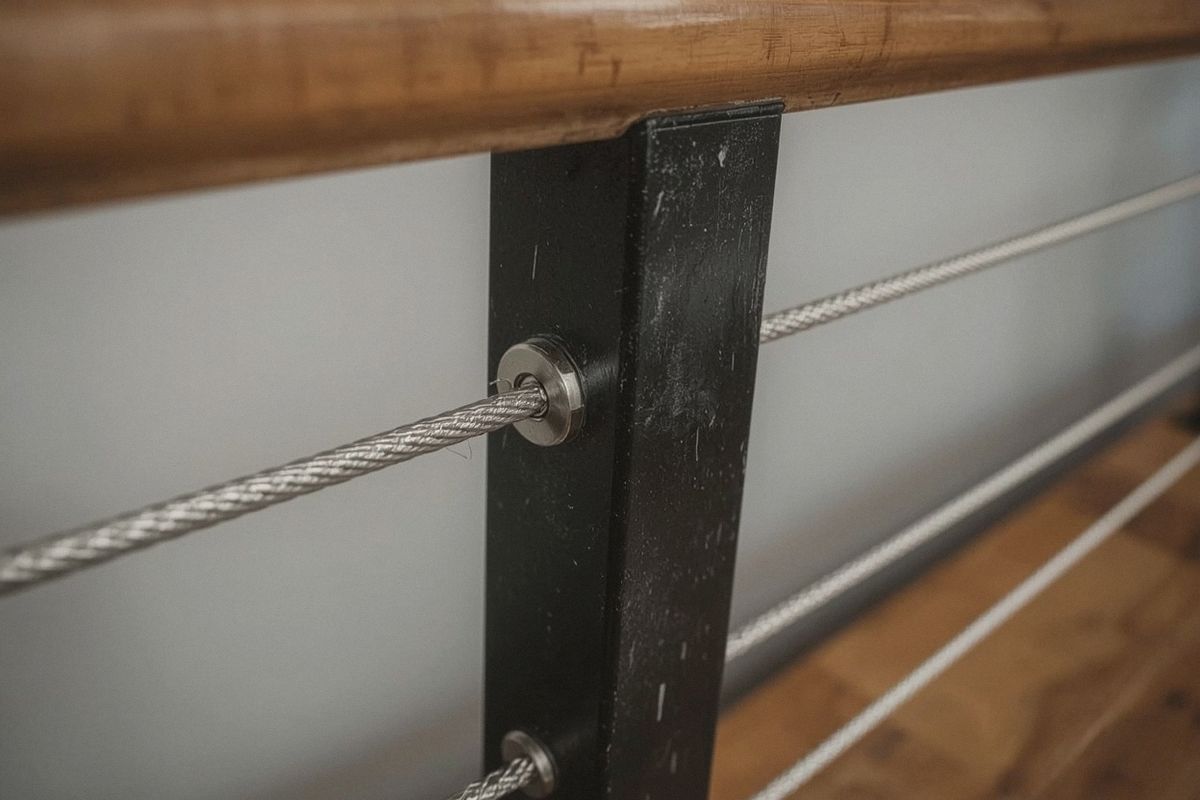
- Steel or aluminum posts and top rail, powder coated in your color, or a hybrid with a wood cap.
- 1x19 316 stainless cable, fittings and tensioners.
- Installation, final tensioning and a sphere check in every bay.
- Permit drawings when the deck work requires them.
Is Cable Right for Your Deck?
Cable is a strong fit when:
- Your deck faces open space, a fairway or the hills, and the view is the point.
- You want a light, modern look that does not hide the deck.
- You are replacing a tired wood rail on a 1980s or 1990s deck with something noncombustible.
- Your HOA accepts metal railings with horizontal infill.
It is a weaker fit for a deck with no room for intermediate posts, or framing too soft to anchor end posts against cable tension. If glass or aluminum pickets would serve you better, we will say so.
Cable Railing Specs and Frame Options
Our standard is 1x19 316 stainless steel aircraft cable in 1/8 inch or 3/16 inch. The 1x19 lay is stiffer and stretches less than flexible rope-style cable, and 316 holds its shine better than 304. Two numbers drive compliance: posts or spacers roughly 4 feet apart, and cables about 3 inches on center.
| Frame | Look | Upkeep | Notes |
|---|---|---|---|
| Powder-coated steel posts | Slim, crisp | Low | Stiffest end posts for long runs |
| Powder-coated aluminum posts | Light, modern | Very low | Easy to match HOA colors |
| Stainless posts | Polished, premium | Low | Highest material cost |
| Wood posts with cable | Warm, rustic | Higher | Combustible; wood shrinks and loosens cable |
Code Compliance and the Ladder-Effect Question
Where a walking surface is more than 30 inches above grade a guard is required, and local departments enforce 42 inches. The 4-inch sphere rule is applied with the cable pushed, not at rest, which is why spacing near 3 inches and posts near 4 feet matter. End posts must resist the combined pull of every cable, and the top rail must carry a 200-pound concentrated load.
Parents often ask whether horizontal cables act as a ladder. The California codes used for single-family homes do not include a climbability rule, so cable is generally allowed on houses. Some HOAs, inspectors and commercial projects view it differently, so we confirm before drawing and talk honestly about young climbers.
Our Process
Walk the Deck
We check framing, measure runs and mark which views matter most.
Lay Out the Bays
Posts, spacers and cable heights are drawn so every opening stays under 4 inches.
Code & Engineering Check
End-post anchorage and top-rail loads are confirmed before fabrication.
Fabricate Posts & Rail
Posts are cut, drilled for cable and welded in our shop.
Powder Coat
Frames are cleaned, coated and oven-cured in your chosen color.
Install, Tension & Test
Cables are run, tensioned and sphere-tested bay by bay.
Built for San Ramon Valley Conditions
Two local conditions shape our cable work. First, fire: the State Fire Marshal's 2025 maps added High and Moderate local zones for the first time, parts of eastern Dougherty Valley are mapped High, and Danville has Very High areas. A railing sits at the ember-catching edge of a deck, and stainless cable on metal posts gives embers nothing to burn. Second, heat: metal frames move on hot afternoons in Danville and Alamo, so we leave tensioners with room to adjust and show you how to check them after the first summer. Check your address at osfm.fire.ca.gov/fhsz.
Cable Railing Cost in San Ramon
Cable railing typically runs $75–$260 per linear foot installed. A 50-foot deck averages around $9,000, and most projects land between about $3,750 and $13,000. The main cost drivers:
- Frame material: aluminum, steel, stainless or wood.
- End and corner posts, since each turn adds roughly 20–30%.
- Stair sections, which need angled fittings.
- Deck framing that needs blocking before it can hold tension.
- Permits at about $50–$500, and hillside access.
Weighing materials? Our cable vs glass vs iron comparison covers heat, views and HOA fit. For a firm number, call (925) 438-6219.
Why Choose Us
Sphere-Tested Bay by Bay
After final tensioning we push a 4-inch test sphere between cables at the middle of every bay, where cable deflects the most. If it slips through anywhere, we add tension or an intermediate spacer before we pack up. That check is part of every cable job we install, and it is the same test a building inspector uses.
Noncombustible From Post to Cable
Metal posts, a metal top rail and stainless cable make a guard with no fuel in it. With the 2025 fire hazard maps showing High zones along parts of the eastern Dougherty Valley edge and Very High areas in Danville, many owners are retiring wood rails for that reason. We spell out which parts of your system are metal end to end.
Framing Checked Before Tension
A cable end post is pulled far harder than a picket post. Before we quote, we look under the deck at blocking, rim joists and post connections, and we draw through-bolted, reinforced end posts where the framing needs help. That is how a cable rail stays tight instead of slowly bending the rim joist outward. If the framing is beyond reinforcement, you hear that before you pay for cable.
Available Across the Tri-Valley
Our cable railings go on view decks in San Ramon, Danville, Alamo, Pleasanton, Dublin and Walnut Creek, from hillside lots facing Las Trampas to backyards looking toward Pleasanton Ridge.
Related Services
Compare a wind-blocking option in our glass railings, see the full range of deck and balcony railings, choose aluminum railings for a powder-coated frame, or tighten an existing system with railing repair. Read about our team or book a cable railing consultation.
FAQ
Questions, Answered
Straight answers on cost, code, permits and materials. Still unsure? Call and ask.
Is cable railing legal in California?
Yes, when it is built correctly. The guard must be 42 inches tall where the deck is more than 30 inches above grade, and a 4-inch sphere must not pass between cables even when they are pushed. That is why we keep posts about 4 feet apart and cables about 3 inches apart. Some HOAs set their own rules, so check before you commit.
Why do cable railings sag, and can you fix it?
Sag usually comes from posts spaced too far apart, end posts that flex, or wood framing that shrinks and lets tension go. Re-tensioning helps briefly, but lasting fixes add intermediate spacers or stiffen the end posts. We inspect the whole system first, then recommend the smallest repair that keeps every bay passing the 4-inch sphere test.
Should I choose 1/8 inch or 3/16 inch cable?
Both work in a properly built frame. 1/8 inch cable is the most discreet and nearly vanishes against the view. 3/16 inch is visibly bolder, a little stiffer between posts and feels more substantial to the hand. We often suggest 3/16 inch on longer bays or busy family decks, and 1/8 inch where the view is everything.
Can cable railing go on deck stairs?
Yes. Stair sections use angled fittings so the cables follow the slope, and the guard still has to block a 4-inch sphere. Stairs also need a graspable handrail set 34–38 inches above the nosing, which a wide flat top rail does not provide, so we usually add a round handrail or a grip rail on the inside of the posts.
Cable or glass for a San Ramon view deck?
Cable usually costs less, lets breezes through and needs only occasional tension checks. Glass costs more and shows water spots, but it blocks wind on exposed decks and has no horizontal lines in the view. Both are noncombustible. If your deck catches strong afternoon wind, glass is often worth the premium; otherwise cable is the value choice.
Free on-site estimate
Ready to get started?
San Ramon Custom Railing designs, fabricates and installs custom railings across San Ramon, CA and the Tri-Valley. Licensed and insured, drawings checked against California code, and permit and HOA paperwork handled for you.